The kitchen worktop is dusted with a fine scattering of rye flour, the kettle has not quite boiled, and you are staring down a wicker banneton. You have spent three days coaxing wild yeast into a frenzy, mixing water and flour, stretching and folding a sticky, unruly mass into a taut, promising sphere. The air smells slightly sour, a rich, fermented tang that promises a deeply flavourful breakfast.
Standard baking lore often whispers that a warm, room-temperature environment is your greatest ally for the final stages of bread making. You let the shaped dough sit out, watching it grow soft and fragile as the morning light hits it, believing this warmth will guarantee an airy, open crumb. Yet, when you draw your razor across that plump, relaxed surface, the blade catches and snags, dragging the delicate skin rather than parting it cleanly.
Twenty minutes later, when you lift the heavy cast iron lid to reveal the bake, the bread tastes perfectly fine, but it looks weary and somewhat flat. It lacks that proud, sweeping ridge—the baker’s ear—that signals a loaf worth six or seven pounds in a high-end artisan bakery window. The aesthetic payoff, the visual authority that makes a home-baked loaf look staggeringly professional, is entirely absent.
The truth hidden behind those professional glass counters contradicts almost everything you have read about keeping your shaped yeast warm before the oven. You do not want a relaxed, pillowy canvas when you make your primary cut; a chilled surface creates tension, locking the internal pressure in place until the exact moment it meets the scorching heat of your pre-heated cast iron.
The Physics of a Cold Cut
Think of warm sourdough as trying to tailor a dress out of wet silk. It moves unpredictably, it yields to the blade, and it collapses under the slightest pressure of the shears. A chilled dough, fresh from an overnight rest at four degrees Celsius, behaves far more like a piece of stiff, heavy canvas, ready to be shaped with absolute precision.
This firmness is precisely where you find your visual authority and structural control. When the exterior is tightly bound by the cold, the interior gases are trapped like a coiled spring, ready to forcefully burst outward the moment the crust begins to bake. When you score cold dough, the lame glides without any resistance, slicing through the tight outer membrane with a satisfying, clean separation.
Consider Thomas, a 42-year-old night-shift baker working out of a cramped, flour-dusted railway arch in East London. For years, he struggled with inconsistent expansions, watching his high-hydration loaves spread out into flat discs rather than spring vertically into proud, rounded boules. He tried altering his feeding schedules, swapping out local flours, and even adjusting the humidity of his proofing racks.
His turning point was not a rare stoneground grain or a highly complex hydration ratio, but the strict, unforgiving rule of the walk-in fridge. He shapes his loaves, retards them for fourteen hours in a cold environment, and turns the dough out directly onto cold baking parchment. The blade goes in swiftly, and the dough goes immediately into a 250-degree oven, resulting in an ear sharp enough to blister the roof of your mouth.
Adapting the Chill to Your Crumb Style
Not every home baker wants the exact same aesthetic finish, and the cold-score technique adapts beautifully depending on what you value most in your morning routine and your desired crust texture. The chilling process is not just about the ear; it is about absolute control.
For the Intricate Artist: If you enjoy etching delicate leaves, wheat sheaves, or complex geometric patterns into your crust, the cold surface is entirely non-negotiable. A warm, wobbly dough will simply swallow your shallow cuts as it expands, blurring your design. The rigid skin holds every fine blade detail, allowing you to create a high-contrast pattern that looks like an expensive masterpiece you would hesitate to slice into.
- Scrubbing cast iron with coarse salt removes stubborn carbon without stripping the seasoning
- Storing your extra virgin bottle next to the hob destroys its polyphenol count in days
- Adding double cream before the heat is reduced triggers immediate separation
- Chefs confirm this two-ingredient batter adjustment guarantees a flawless rise every time
For the Weekend Pragmatist: You no longer need to hover over a proving basket on a Sunday morning, poking the dough every ten minutes to check its bounce and fretting over whether it is over-fermented. By retarding the dough in the fridge overnight, you effectively hit pause on the fermentation at its absolute peak.
For the High-Hydration Purist: Wet doughs, pushing past the eighty percent hydration mark, are notoriously difficult to handle, often spreading into flat puddles the moment they leave the support of the basket. Scoring them straight from the fridge forces the structure to remain upright, directing the steam vertically rather than outwards during the critical first minutes of the bake.
The Mechanics of the Perfect Cut
Executing this high-end aesthetic requires a noticeable shift in your physical movements. You must be deliberate, incredibly fast, and entirely unsentimental about getting the cold dough straight into the blistering heat.
Turn the cold dough out onto your baking parchment, but do not step away to fetch your lame or find your oven gloves. The longer the dough rests on the warm kitchen worktop, the more condensation builds on the surface, making it sticky and difficult to slice. You must work incredibly quickly to maintain that beautiful, tense surface structure.
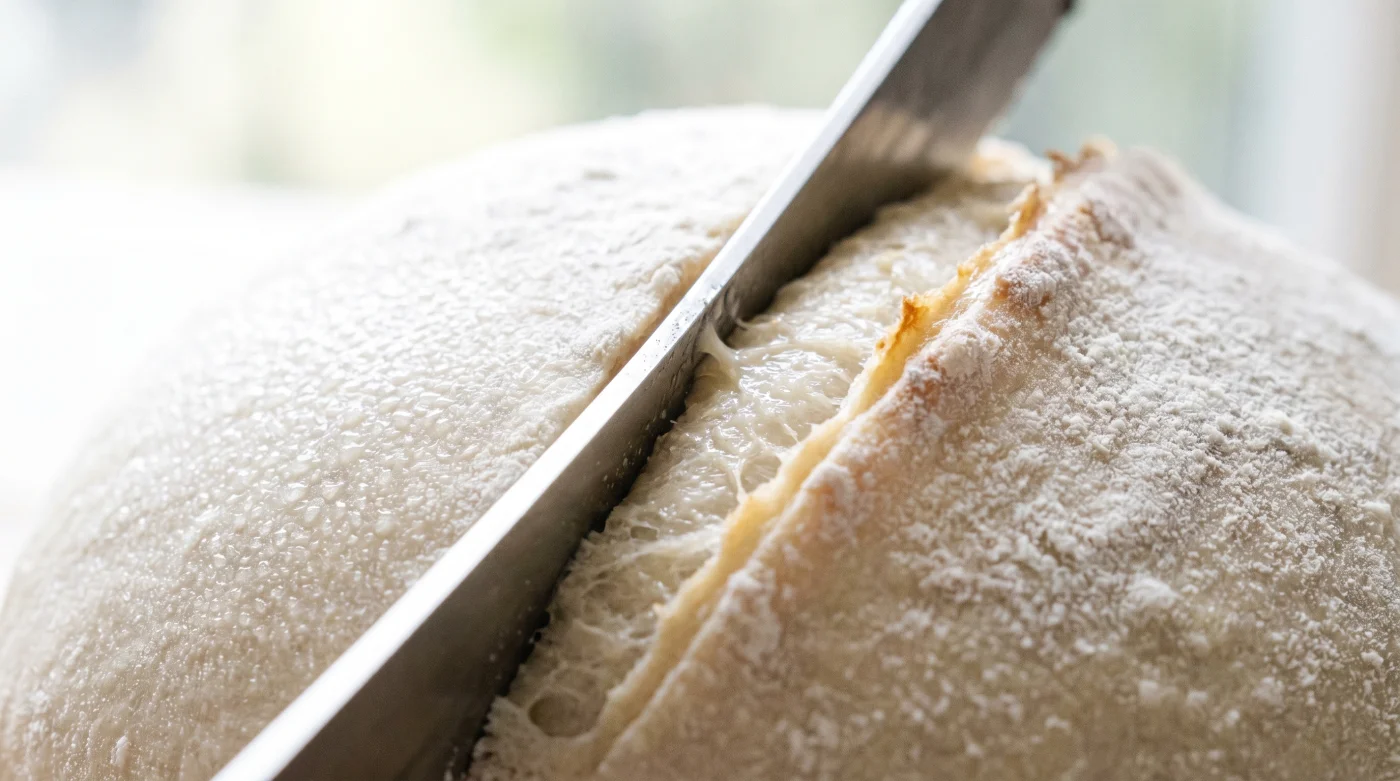
Hold your razor blade at a strict thirty-degree angle relative to the worktop. You are not chopping straight down into the middle of the loaf as if slicing a cake; you are slipping the sharp edge just beneath the outer skin to create a thin flap of dough.
Move your arm rapidly. Hesitation is the absolute enemy of a clean, professional score. You want a single, fluid motion originating from your shoulder, pulling from the top third of the dough down to the bottom third, slicing cleanly without any snagging.
The tool itself also matters immensely. A dull blade will drag regardless of how cold your dough is, pulling the gluten strands and causing microscopic tears that ruin the clean aesthetic of your loaf. You must treat your lame with the same respect a chef gives their favourite knife.
Change the razor blade frequently, ideally after every fifth bake, to ensure the edge remains terrifyingly sharp. When you prepare to make that final cut, wipe the steel briefly with a damp cloth; a slightly wet blade glides through the chilled dough, preventing friction and rough edges.
Consider this your tactical toolkit for ensuring the perfect cold-score every single morning. Keep your fridge running reliably between three and four degrees Celsius. Score and transfer the dough to the heat within sixty seconds of it leaving the basket, aiming for roughly a centimetre and a half beneath the surface skin.
By sticking to these rigid, professional parameters, you completely eliminate the guesswork that plagues so many home kitchens. The anxiety of the final bake dissipates, replaced by a quiet, steady confidence in your own physical technique. You dictate the weak point, forcing the loaf to bloom exactly where you instructed the steam to escape.
Beyond the Bake
Mastering this single, fleeting motion changes your entire relationship with bread making. You no longer watch nervously through the oven door with crossed fingers, blindly hoping the dough magically finds its shape in the dark heat.
It turns a chaotic, unpredictable biological process into a reliable, beautiful morning ritual. The satisfaction of pulling a loaf from the oven, hearing the blistered crust crackle and sing as it cools on the wire rack, justifies the overnight wait entirely. It feels far less like following a recipe, and a lot more like quiet mastery.
"The ear of a sourdough loaf is not an accident of heat; it is the deliberate result of cold, calculated tension meeting sudden, violent energy."
| Key Point | Detail | Added Value for the Reader |
|---|---|---|
| Surface Temperature | Chilled to 4°C overnight | Prevents blade snagging and creates a clean, professional aesthetic. |
| Blade Angle | Held at a strict 30-degree offset | Forces the dough to peel back into an ‘ear’ rather than splitting wide open. |
| Execution Speed | Score within 60 seconds of fridge removal | Stops condensation from forming, ensuring the crust remains rigid and workable. |
Frequently Asked Questions
Will baking cold dough increase my baking time?
Only marginally. The extreme heat of a pre-heated Dutch oven quickly penetrates the cold dough. You may need an extra two to three minutes with the lid off to achieve a deeply caramelised crust.Can I put my room-temperature dough in the freezer just before scoring?
Placing room-temperature dough in the freezer for twenty minutes can firm up the outer skin, but it will not provide the deep structural benefits of an overnight retard in the fridge.Why is my lame still dragging on cold dough?
Your blade is likely dull or you are holding it at a ninety-degree angle. Replace your razor after every few bakes and ensure you are slicing at a shallow thirty-degree angle.Do I need a special lame to score properly?
No. A simple double-sided razor blade held carefully in your fingers works perfectly, though a handle provides safer, more consistent leverage for curved cuts.Does this method work for highly enriched doughs?
Enriched doughs containing butter or eggs firm up significantly in the cold, making them very easy to score. However, they may require a slightly longer rest at room temperature before baking to ensure an even crumb.